6 principles for traders: a complete trading philosophy
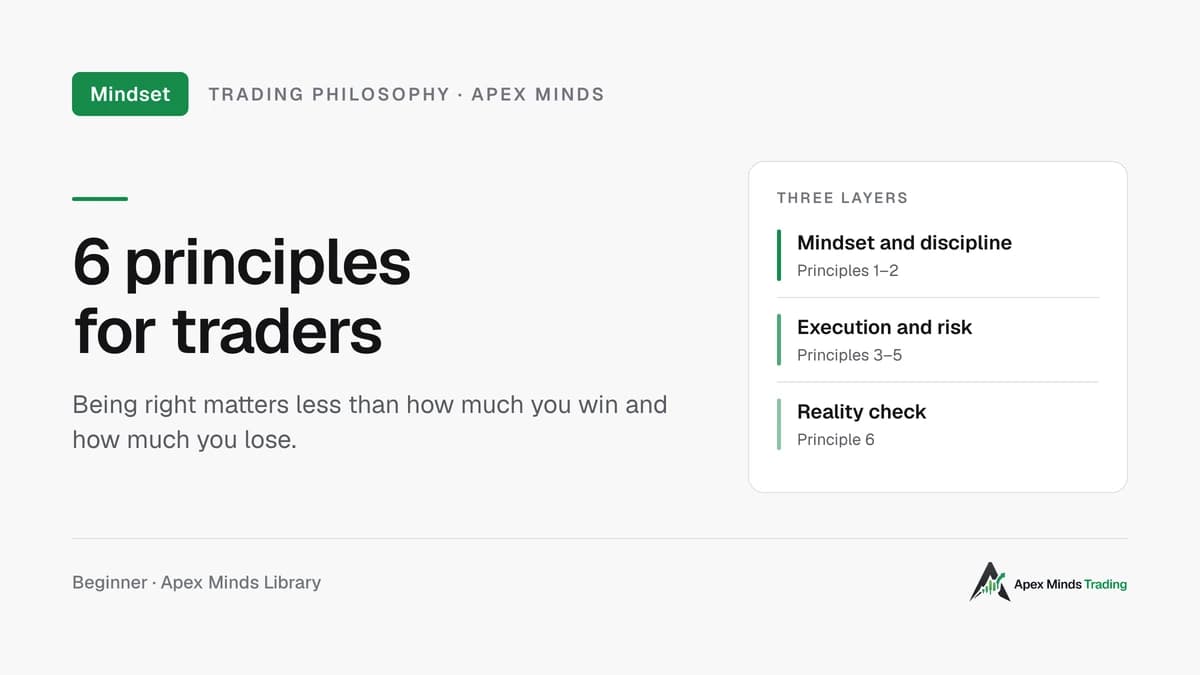
Being right or wrong matters less than how much you make and how much you lose. Six principles in three layers: mindset, execution, and respect for the market.
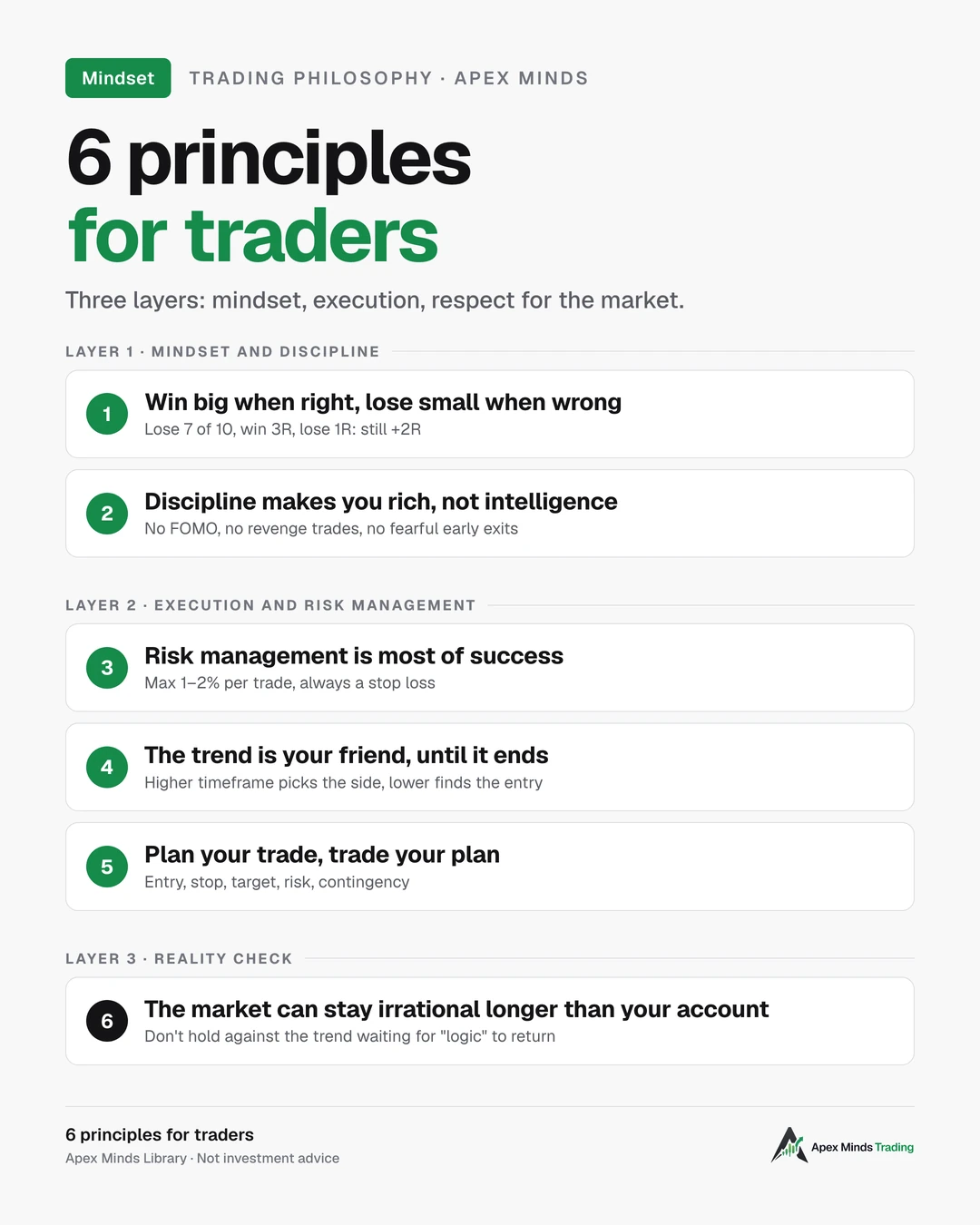
If we had to fit the most important things about trading onto one page, Apex would write six lines:
- Trading is not about being right or wrong, but about making a lot when you're right and losing little when you're wrong.
- Discipline makes you rich, not intelligence.
- Risk management is most of trading success.
- The trend is your friend, until it ends.
- Plan your trade, and trade your plan.
- The market can stay irrational longer than you can keep your account alive.
On their own, each line sounds like a slogan. Together, they form a philosophy with three layers:
- Principles 1–2: mindset and discipline. How you think about winning and losing, and whether you actually do what you think.
- Principles 3–5: execution and risk management. How you protect capital, pick a side, and get in and out of trades.
- Principle 6: reality check. The market is always bigger than you.
This article goes through each principle: why it holds, what the classic books say, and what you can apply right away to gold and forex.
Layer 1: Mindset and discipline
Principle 1: Not right or wrong, but how much you win and how much you lose
This line is often attributed to George Soros. It was actually said by Stanley Druckenmiller, describing the most important lesson he learned while managing money for Soros. The story appears in Druckenmiller's interview in Jack Schwager's The New Market Wizards (1992).
Beginners often score themselves by win rate: 7 winners out of 10 is good, 3 out of 10 is bad. The market doesn't score that way. The market only adds up money.
To see this clearly, you need a unit called R. R is the amount you accept to lose if the trade is wrong, that is, the distance from your entry to your stop loss (the price at which you close the trade to cap the loss). A trade that makes three times the amount risked is a 3R winner.
Now the math. You take 10 trades, lose 7, win 3:
- 7 losers at 1R each: −7R.
- 3 winners at 3R each: +9R.
- Total: +2R.
You were wrong 70% of the time and still made money. In contrast, someone who wins 8 out of 10 trades at 1R each, but holds two losers until they lose 5R each: +8R − 10R = −2R. Right more often, and still losing.
Mark Douglas, in Trading in the Zone, calls this probabilistic thinking: each individual trade is random, but a long enough series of trades leans toward whoever has the edge. He uses the casino as an example: a casino doesn't need to predict each hand, only a small edge repeated over a great many hands. Adam Grimes, in The Art and Science of Trading, also notes that real edges are usually thin, around 55/45, so they must be judged over many trades.
The next step after that calculation is expectancy per trade. If you know your win rate and average R, you can work out what an average trade brings:
Expectancy = (Win rate × average R on winners) − (Loss rate × average R on losers)
For the first example: (0.3 × 3R) − (0.7 × 1R) = 0.9R − 0.7R = +0.2R per trade. That number is what decides whether you should keep trading the method. It also tells you how many trades you need before results show: +0.2R expectancy means you'd expect about +20R after 100 trades, but any run of 10 trades can stray far from that.
Note: this example doesn't include spread and commissions. With gold, spreads around news can be very wide, so calculate R after costs.
Apply it now: before every trade, write down R (how much you lose if wrong) and your target in R. If the target is below 2R, consider skipping it. At the end of the month, grade yourself by total R, not win rate.
Principle 2: Discipline makes you rich, not intelligence
Knowing principle 1 is easy. Doing it is hard. The three mistakes that break principle 1 most often are all discipline mistakes, not knowledge mistakes:
- FOMO (fear of missing out): price starts running and you jump in, without waiting for the planned entry.
- Revenge trading: right after a painful loss, you take a bigger trade to "win it back".
- Exiting early out of fear: the trade is up 1R, price wobbles and you close it, while the plan was 3R. The +2R math above collapses immediately.
Douglas identifies four root fears of traders: fear of being wrong, fear of losing money, fear of missing out, and fear of leaving money on the table. In his view, most money-losing mistakes come from how we react to these four fears. He also describes revenge trading vividly: after a shocking loss, the trader wants to conquer the market, and that is when the account takes the worst damage.
The good news is that Douglas treats self-discipline as a technique, not an inborn trait. Anyone can build it, with specific goals and consistent record-keeping.
Apply it now:
- Set a session stop rule: two losses in a row, or −2R for the day, and you close the platform.
- Add a column to your trading journal: "Was this trade according to plan?" Measure progress by the number of trades that followed your rules, not by money.
Layer 2: Execution and risk management
Principle 3: Risk management is most of success
The "90%" figure is a familiar saying among traders, not a research result. But every book agrees with the idea behind it: the people who last in this business are not the best forecasters, but the best risk managers.
Andrew Aziz, in How to Day Trade for a Living, compares success to a three-legged stool: psychology, strategy and risk management. Beginners usually focus only on strategy. He sees failing to control losses as the number one reason beginners fail.
Risk management comes down to three things, and you need to be able to do all three by hand, not just understand them.
Position sizing (calculating trade size from the amount you accept to lose). Risk per trade is capped at 2% of the account, the limit both Aziz and Bob Volman (Understanding Price Action) set. For gold on MT4/MT5, a standard lot is usually 100 ounces (common at most brokers; check the contract specification in your MT5), so every 1 USD move equals 100 USD per lot. The formula:
Lot size = (Account × % risk) ÷ (Stop distance in USD × 100)
A concrete example. Account 10,000 USD, 1% risk = 100 USD. You buy gold at 4,200 with a stop at 4,195, a distance of 5 USD/ounce. Lot size = 100 ÷ (5 × 100) = 0.2 lots. If the technical stop has to be further away, say 10 USD/ounce, the size automatically drops to 0.1 lots. You never widen risk to keep your size; you only cut size to keep your risk.
Stop losses. The math is simple: the deeper the loss, the harder it is to recover. A 10% loss needs an 11% gain to break even. A 50% loss needs 100%. Grimes points out that percentages don't add and subtract directly: lose 10% then gain 10% and you're still below where you started.
In practice: place the stop at the moment you enter, in the same click, not "later". With a 10,000 USD account, a 0.2-lot gold trade with a 5 USD/ounce stop means you already know the expected loss is 100 USD. Barring heavy slippage on news or a weekend gap, that number doesn't change wherever price goes.
Don't average down. Aziz calls adding to a losing trade one of the most common beginner mistakes. It often "saves" the trade, but the one time it doesn't can wipe out the whole account.
This is where it's easiest to fool yourself, so you need a hard rule: once price hits the stop, the trade is closed, no exceptions. If you still believe price will come back, only open a new trade when there is a new setup that fits your plan, with a new R. That way you keep your view, but the old loss isn't left hanging over the account.
Apply it now: before every trade, calculate the size with the formula above. If the technical stop forces you to risk more than 2%, skip the trade.
Principle 4: The trend is your friend, until it ends
This is a Wall Street saying popularised by analyst Martin Zweig. Nobody knows for sure who said it first.
Trading with the trend is the least stressful way to trade. When you trade in the direction of the main flow, counter-moves are just small waves, and the main push is on your side. Trading against the trend is the opposite: every major leg hits your position.
Dow Theory, through Robert Rhea's The Dow Theory, divides the market into three movements. The primary trend lasts a year or more. Secondary reactions last a few weeks to a few months, often retracing about a third to two thirds of the primary move. Daily fluctuations usually don't matter. Picture the tide and the waves: waves can hit the other way, but the tide decides whether the water rises or falls.
But "trade with the trend" is empty advice unless you say how the trend is defined. Three criteria you can use on gold right away:
- Highs and lows. On D1, if highs and lows keep rising, the trend is up. When a D1 candle closes below the most recent low, the uptrend structure is broken: stop buying. If a lower high follows, the downtrend is confirmed.
- Moving averages. A D1 close above the MA200 is a bullish context; below it is bearish. The MA50 crossing below the MA200 (a death cross) is a sign of deterioration, not an entry signal.
- Slope. A strong uptrend makes clearly higher highs with shallow pullbacks. When highs start to flatten and pullbacks get deeper, the trend is weakening even if it hasn't broken.
The second half of the saying is the hard part: "until it ends". No trend lasts forever. That's why trend following still needs stop losses. A stop is how the market tells you the trend may have changed.
Apply it now: use multi-timeframe analysis. The higher timeframes (D1, H4) choose the side, Buy or Sell. Lower timeframes are only for finding entries in that direction. If the higher timeframe is falling, don't buy, however "cheap" M15 looks. And when a D1 candle closes below the most recent low of the uptrend, that's when "the trend is your friend" becomes "the trend may have ended".
Principle 5: Plan your trade, and trade your plan
The plan is written before you open the trade, while your head is clear. Once the trade is running, emotions start talking.
Douglas writes that what draws people to trading is almost unlimited freedom. Nobody assigns you work, nobody makes you stop. That is both a gift and a curse: no outside rules hold you back, so traders must set their own.
A minimum trade plan has five lines:
- Entry: at what price, and why (which setup).
- Stop loss: where the idea is proven wrong.
- Take profit: the target in R.
- Risk per trade: what % of the account, and the resulting size.
- Contingency plan: what to do before major news, what to do if you lose connection, and skip it if price runs away without coming back to your entry.
One tool that helps you "trade your plan" is an order with stop loss and take profit attached (bracket or OCO) placed at entry. Volman advises traders prone to panic or greed to trust the bracket more than their own perception while in a trade. Douglas also warns: every time you intervene manually outside the plan, you add a random variable to the system, and the results can no longer be measured.
Apply it now: write those five lines in your journal before you click. If you can't write one of them, don't enter yet.
Layer 3: Reality check
Principle 6: The market can stay irrational longer than you can keep your account alive
This line is usually attributed to economist John Maynard Keynes. In fact there is no evidence Keynes ever said it. According to Quote Investigator, a site that traces the origins of quotations, the earliest known use is by economist A. Gary Shilling in 1986, 40 years after Keynes died. Whoever said it, the lesson holds.
This may be the most painful lesson. Many traders blow up not because their analysis was wrong, but because it was right too early. They see price as "too high", sell, then hold the trade against the trend because they believe the market "has to return to logic". The market has no such obligation.
Gold is the clearest example. In early August 2020, gold set a high of about 2,070–2,075 USD/ounce (the intraday high on 7 August 2020). Many people thought it had risen too far and had to correct.
They were partly right: by March 2021, gold had fallen to about 1,676 USD. But anyone who kept insisting "gold is too expensive" was wrong over the longer run:
- In March 2024, gold broke clearly above its 2020 high.
- On 14 March 2025, it crossed 3,000 USD intraday for the first time.
- On 8 October 2025, it crossed 4,000 USD.
- In late January 2026, it reached about 5,590 USD intraday.
At every one of those levels, someone thought "it's overbought, it has to fall". A short at 3,000 USD "because it's too high" without a stop would have had to sit through more than 2,500 USD per ounce against it.
And the other half of principle 4 holds too: every trend ends eventually. By mid-October 2026, gold was around 4,170 USD, roughly 25% below the peak. Someone who chased the top without a stop paid just like the early seller. Both made the same mistake: thinking they knew where the market "had to" go.
Douglas writes that the market owes nobody anything, and the first of his five fundamental truths is that anything can happen. Brian Pezim, in How to Swing Trade, describes the five stages of holding a losing trade: denial, anger, bargaining, depression, and finally acceptance, usually with a loss much larger than planned.
Apply it now:
- Don't sell just because price "has risen too much", or buy just because it "has fallen too far". Wait for price structure to confirm.
- A stop loss is what keeps you in the market when you're wrong. Don't move it further away.
- Never add to a trade that is going against the trend.
Putting the six principles together
- Mindset (1): measure success in R, not win rate.
- Discipline (2): do what you planned, even when afraid.
- Protect capital (3): small risk per trade, clear stops.
- Pick a side (4): trade with the main trend.
- Prepare (5): write the plan before entering.
- Humility (6): the market is always bigger than you.
Without layer 1, you don't know what game you're playing. Without layer 2, an ordinary losing streak is enough to wipe out the account. Without layer 3, one stubborn trade can take away everything layers 1 and 2 have built.
If you pick only one thing to do today: open your trading journal, record R for every trade, and add a column for "according to plan?".
References
- Mark Douglas, Trading in the Zone.
- Andrew Aziz, How to Day Trade for a Living.
- Adam Grimes, The Art and Science of Trading.
- Bob Volman, Understanding Price Action.
- Brian Pezim, How to Swing Trade.
- Robert Rhea, The Dow Theory.
- Jack D. Schwager, The New Market Wizards (interview with Stanley Druckenmiller).
- Quote Investigator, "The Market Can Remain Irrational Longer Than You Can Remain Solvent".
- Gold price data: Reuters, World Gold Council.
Trading gold, forex and leveraged products carries a high level of risk and you can lose your capital. This article is for educational purposes only, is not investment advice and does not promise profits. Figures in the examples are illustrations.
