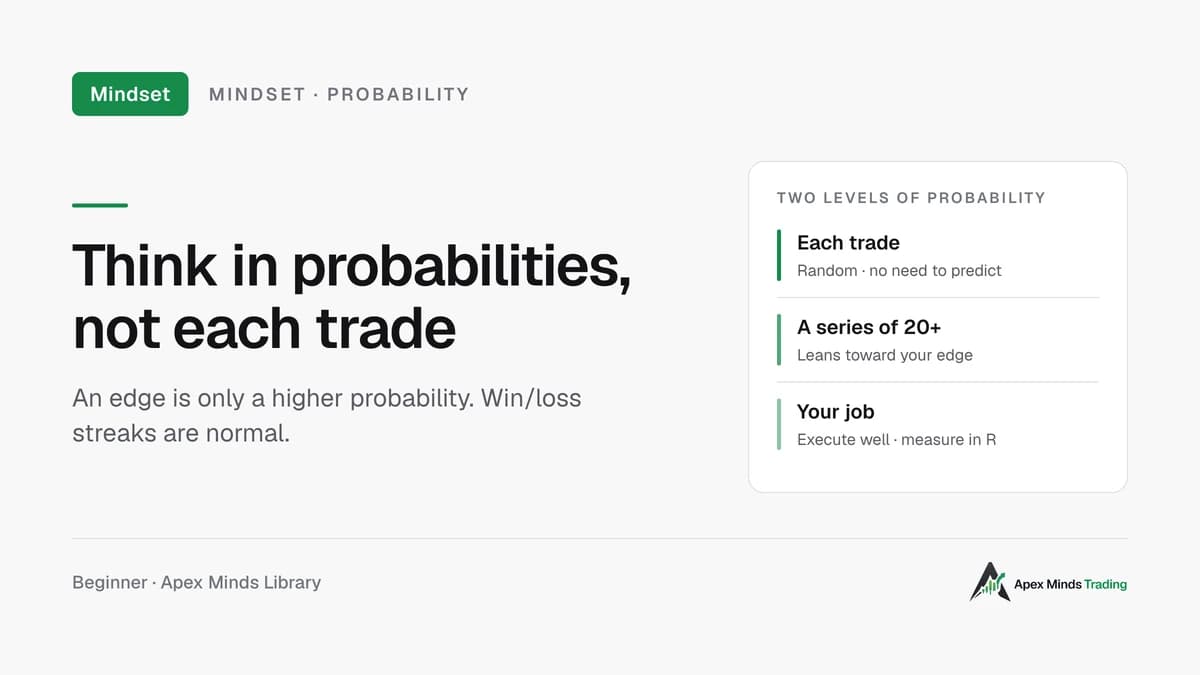
Think in probabilities, not each trade
An edge is only a higher probability. Win/loss streaks are normal.
A casino doesn't know who will win the next hand of blackjack. Yet it makes a profit every year.
Traders tend to do the opposite: they believe the market follows rules, learn more indicators to call it better, and still watch their account swing up and down. Mark Douglas, author of Trading in the Zone, calls this the core paradox of trading, and the answer lies in how you think about probability, not in more analysis.
A casino thinks on two levels
At the blackjack table, the rules give the casino an edge of about 4.5%. Over enough hands, the casino keeps roughly 4.5 cents of every dollar wagered, even when some players go on big winning streaks.
The casino believes two things at once that seem to contradict each other:
- Small level, each hand: the outcome is random, unpredictable, and there is no need to predict it.
- Large level, many hands: the side with the edge is certain to come out ahead over time.
That is probabilistic thinking. Losing traders do the reverse: they pour all their emotion into each trade and forget about the series.
Why a single trade is not the answer
The market does not owe you a specific outcome after every click. A sound process can still lose several trades in a row. That is the random distribution of wins and losses, not proof the system is "broken."
Why is it random when the setup is right? Because price moves on the actions of thousands of other traders. However carefully you analyse, someone is placing the opposite trade, and nobody knows in advance what they will do.
There is another trap: the brain keeps matching the present moment to your last win. A setup that looks "exactly like last time" makes us believe the result will be the same. But for the market, every moment is unique. This time is not last time.
Your edge is only a higher probability across a long enough sample. Say your data shows your setup wins about 12 out of 20 trades. You still don't know which trades will win and which will lose, and you don't need to know that to make money by following the process.
5 truths Douglas asks you to remember
- Anything can happen.
- You don't need to know what happens next to make money.
- Wins and losses are randomly distributed, even with the same edge.
- An edge is just a higher probability, not a certainty.
- Every moment in the market is unique.
Once you truly believe these five things, a losing trade no longer means "I was wrong." As Douglas puts it, with a method that has good odds, every loss brings you closer to a win.
Having a stop is not the same as accepting risk: Bob's story
Douglas tells the story of a student called Bob. Bob understood probability theory very well. He entered a trade with a proper stop loss. Price moved about a third of the way toward his stop, then came back to his entry. Bob closed the trade at break-even. Right after that, price ran 500 points in exactly the direction he had analysed.
Bob couldn't understand why. Douglas pointed out that Bob had a stop but didn't really believe he could be stopped out. When price dared to move against him even a little, he closed the trade as if to "punish" the market.
The lesson: knowing probability is different from trading by probability. The first condition is to accept in advance that this trade can lose, and only then click.
Three habits instead of "calling it right"
- Write the plan before you enter: wait zone, entry conditions, cancel level. No plan means no edge to measure.
- Measure in R, not in feelings: fixed risk per trade (for example 1R). A +2R win and a −1R loss are different math, even when emotions flip them.
- Review in samples, and take every signal: ask whether expectancy is positive after 20–30 trades, not after one red ticket. Probabilistic traders take a trade when the signal meets their rules, whether they like it or not. Skipping trades on feeling means you can no longer measure your edge.
The 20-trade challenge
To turn understanding into reflex, try the exercise Douglas proposes, adapted for XAU/USD:
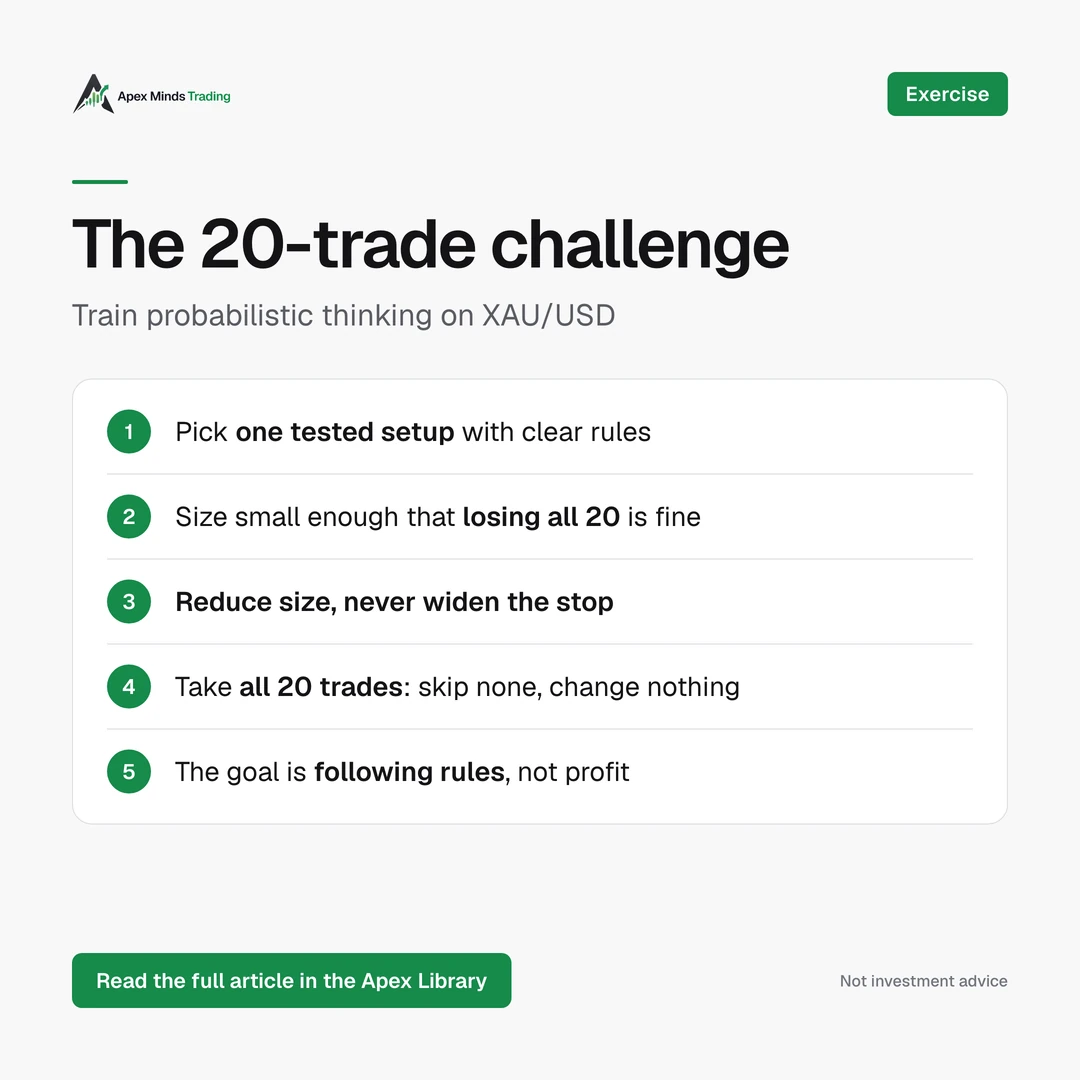
- Pick one tested setup with clear entry and exit rules.
- Use a fixed risk per trade. Choose a position size small enough that losing all 20 trades is still acceptable to you. If not, do it on a demo account.
- Reduce size, never widen the stop to feel comfortable.
- Take all 20 trades on signal: skip none, and don't change the rules midway.
- The goal is to follow the rules, not to make a profit. If it feels hard, reread the 5 truths above.
How this ties to the daily Telegram plan
The library gives you principles. Telegram applies them to today's chart: wait zones, entry conditions, and the level that cancels the plan. You compare price to the plan; you do not force price to match your opinion.
If you are new: read Mindset: why you can be right and still do it wrong for a session routine, a journal and what to do after a loss, then watch plans for a few weeks on a demo account before using real money.
Reference: Mark Douglas, Trading in the Zone. The 20-trade challenge is Apex's adaptation of the book's exercise. This article is not investment advice.
