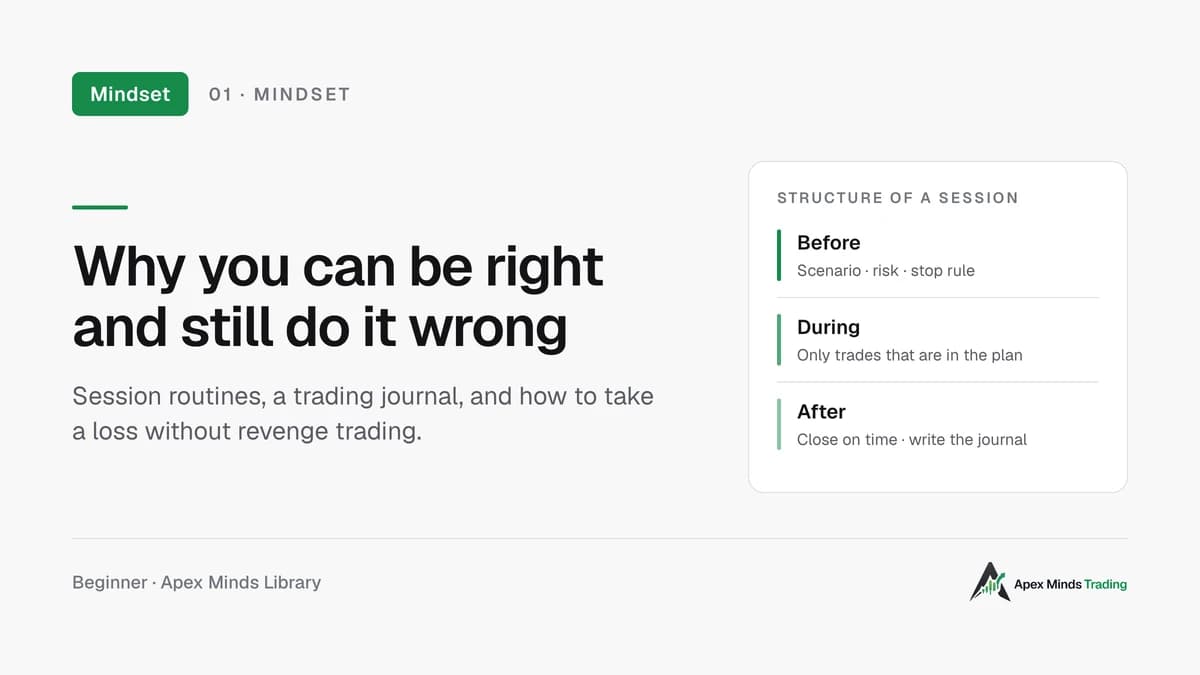
Mindset: why you can be right and still do it wrong
Session routines, a trading journal, and how to take a loss without revenge trading.
You know you should honour your stop loss. You know you shouldn't take trades outside your setup. You know that after a loss you shouldn't double your size to win it back.
Then, during the session, you do exactly what you know is wrong. Only after closing the platform do you ask yourself: "I knew that — why did I do it?"
It isn't a lack of knowledge. Mark Douglas, author of Trading in the Zone, explains that fear narrows our focus. What we have learned temporarily "disappears" and only returns once the fear has passed — usually after the trade is closed.
Worse, the brain has a built-in pain-avoidance mechanism. When a trade is losing, you only see the candles moving your way and ignore the four going against you. You open another indicator, ask the group chat, look for any reason to hold on. You are not doing it on purpose; your brain is protecting you.
That is why learning another indicator doesn't fix it. Douglas even notes that many traders hesitate more the more they learn, because they are learning to beat the market and never get hurt again rather than to trade better.
The solution is not to know more. It is to build the structure in advance, so you don't have to make decisions when emotions run high. There are three parts.
1. A routine for every session
A casino has rules: you place your bet before you sit down, and every hand has an end where you decide whether to play on. The market has none of that. Nobody forces you to set your risk in advance. There is no start or end. The market will never push you out of a losing trade.
Douglas calls this both a gift (you are in full control) and a curse (there are no boundaries to hold you back). You have to build those boundaries yourself. For XAU/USD, a simple session routine looks like this:
Before the session (15 minutes)
- Mark the price zones and scenarios for the London or New York session
- Write down: allowed setups, risk per trade (e.g. 0.5–1% of the account), the maximum number of trades for the session
- Write down your session stop rule: e.g. after 2 losses or −2R, you are done for the session
During the session
- Only take trades that are in the plan. Sitting still when there is no setup is also doing it right.
- Set SL and TP when you enter and don't move them on emotion
After the session (10 minutes)
- Close the platform on time, even if "price is about to run"
- Write the journal
You are creating a beginning, a middle and an end — something the market will never give you.
2. A trading journal
Douglas tells the story of learning to run. At first he just wanted to "become a runner" and kept giving up. When he switched to a concrete goal — running 5 miles — he bought a notebook and after every run wrote down the date, distance, time and how he felt. He was surprised by how many excuses he could find not to run, and at first those excuses won more than two thirds of the time.
The lesson: discipline is a technique, not a personality trait. Anyone can build it with a clear goal and consistent tracking.
A trading journal should record more than profit and loss. One line per trade, with 6 fields:
- Date / session
- Setup
- Result (in R)
- In the plan? (yes / no)
- Feeling at entry and at exit
- If off-plan: why?
The most important column is "In the plan?". Set your goal on that column — for example, 20 trades in a row that follow the plan — instead of a money target. After a few weeks, the last column will show you clearly when and why you break your rules.
3. Taking a loss without revenge trading
Why do we want to win it back right away? Douglas points to two reasons:
- Revenge. A loss is a shock, especially after a few easy wins. The first reflex is to "get it back" and prove you were right.
- Addiction to random rewards. In experiments, monkeys rewarded at random kept working long after the rewards stopped. Trading rewards us randomly too, which makes "just one more trade" very hard to resist.
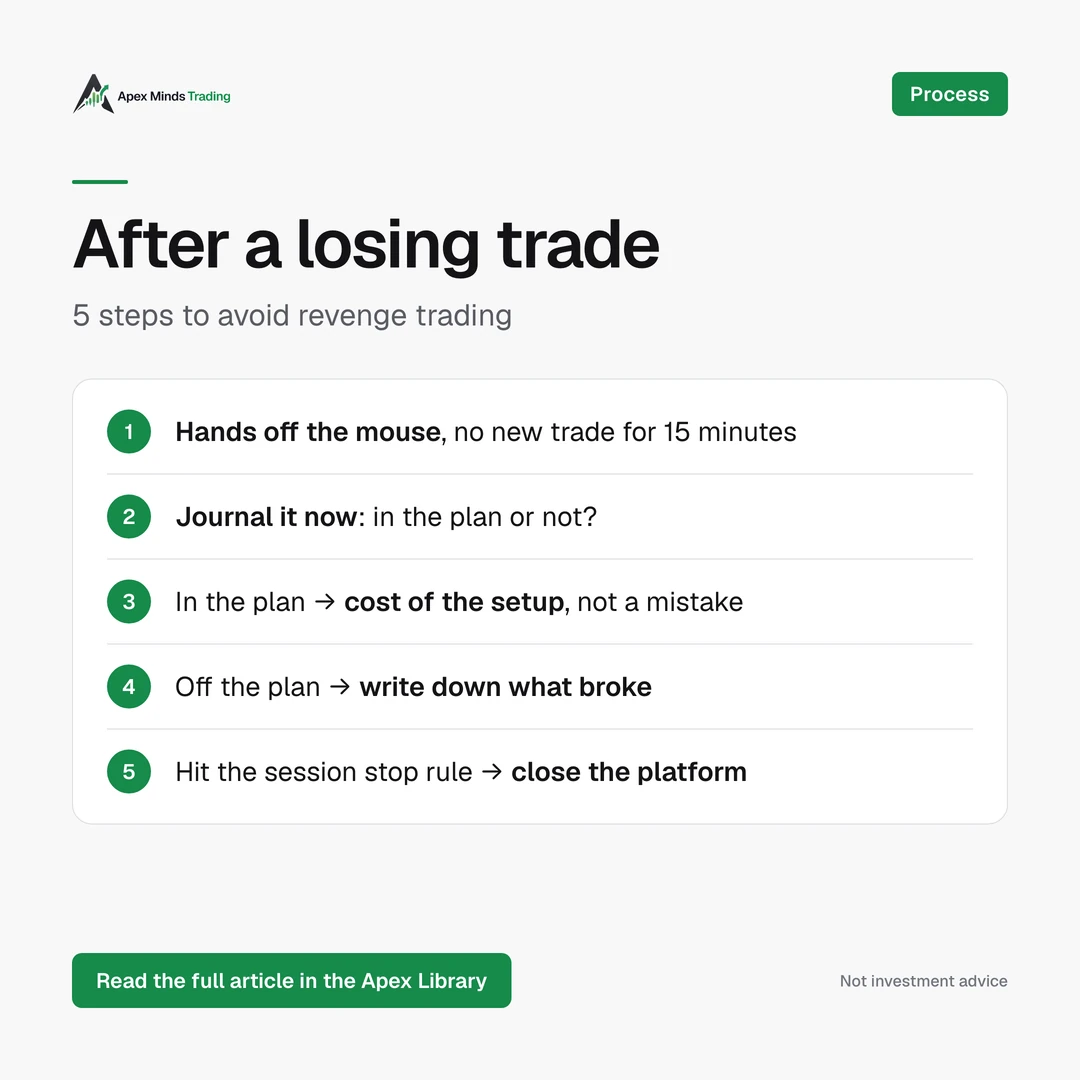
Once your stop loss is hit, follow 5 steps:
- Hands off the mouse. No new trade for 15 minutes.
- Journal the losing trade now: was it in the plan or not?
- If it was in the plan: that is the cost of the setup, not a mistake. With an edge, every loss is just one result in a series.
- If it was off the plan: write down exactly what broke. That is what needs fixing, not the market.
- Check your session stop rule. If you hit it, close the platform. The session is over.
The market doesn't owe you a trade. You don't need to win back the last loss; you only need to execute the next trade correctly.
In short
Being right and still doing it wrong is normal for a human brain under fear. The fix is not more learning but deciding everything important in advance, while your head is calm:
- A session routine creates the boundaries the market doesn't have
- A journal turns discipline into something you can measure
- A post-loss process breaks the revenge loop
To understand why one losing trade doesn't mean you were wrong, read next: Think in probabilities, not each trade.
Reference: Mark Douglas, Trading in the Zone. The session routine, journal template and 5-step process are Apex's application of the book's ideas. This article is not investment advice.
