The trader's three-legged stool: Mind, Method, Money
Remove one leg and the stool falls. Why traders need a steady mind, a method with an edge and disciplined money management, plus 4 daily exercises.
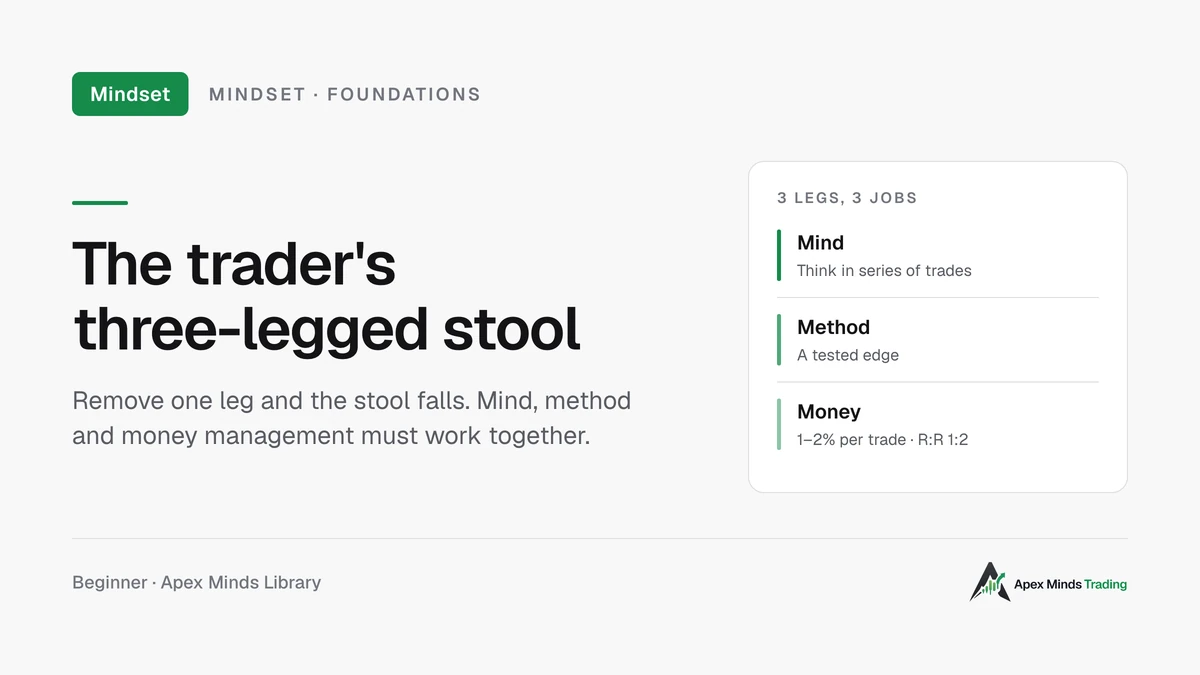
New traders tend to pour almost all their time into one thing: finding a method. New indicators, new systems, new signal groups. A bad week, and they switch methods again. A few months later the account is still going down.
Andrew Aziz, in How to Day Trade for a Living, opens his chapter on risk management with an easy-to-remember image: to succeed you need to master three things, sound psychology, a set of logical trading strategies and an effective risk management plan. They are like the three legs of a stool: remove one and the stool falls. He also says plainly that focusing exclusively on strategies is a typical beginner's mistake.
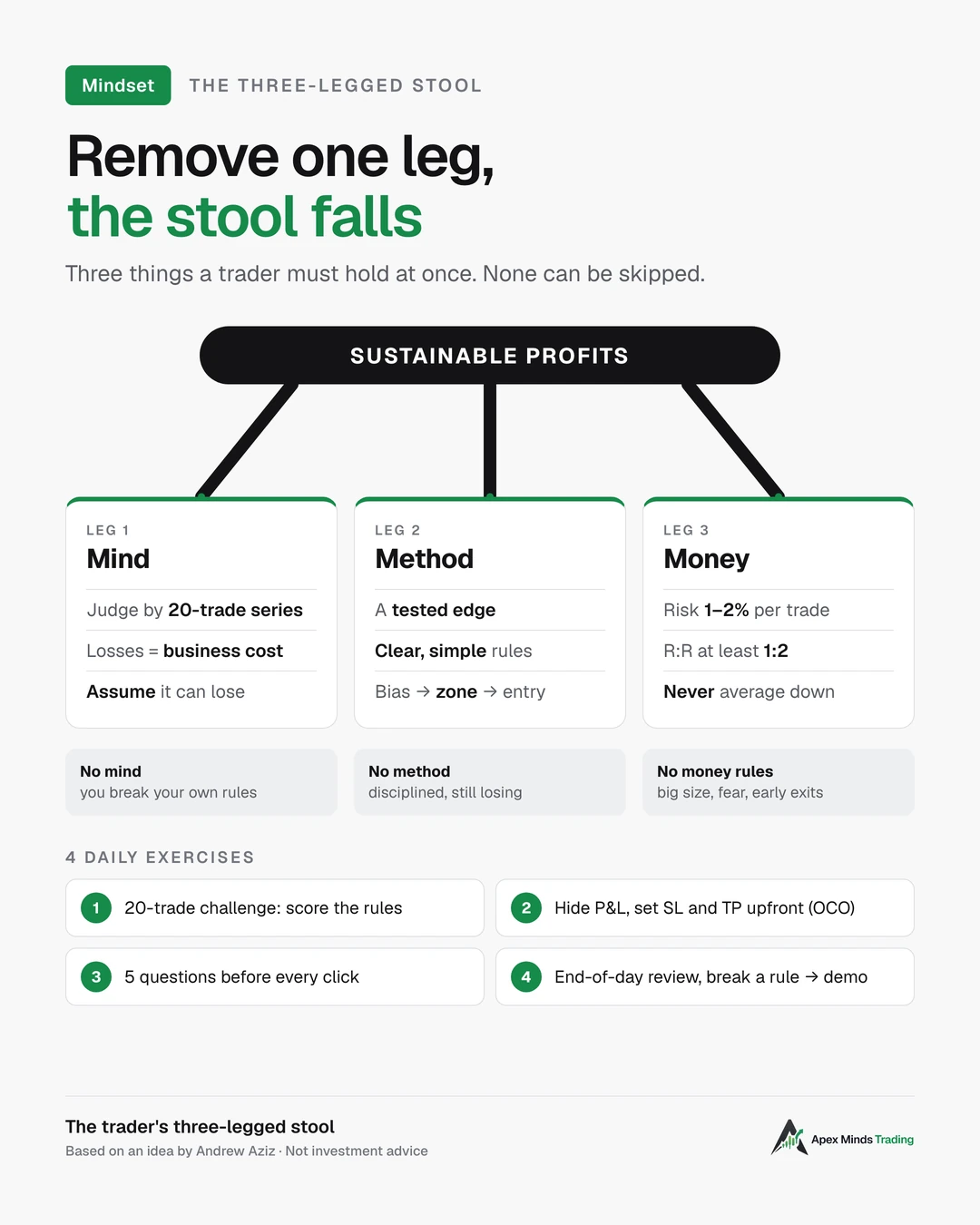
Why does one missing leg bring it down?
The three legs don't stand alone; they hold each other up:
- Mind without method: you are calm, disciplined, you cut losses in the right place, but your method has no edge. The result is losing money very calmly. Discipline doesn't turn a losing method into a winning one.
- Method without money management: a good setup, but every trade is too big. The bigger the trade, the bigger the fear, and fear breaks your psychology: you move stops, exit early, then abandon the method altogether.
- Method and money management without mind: you know the rules, but while in a loss you break your own stop rule, and when frustrated you take trades outside your setup.
The three sections below go through each leg: what it is, why it matters and what to do every day.
Leg 1 – Mind: four principles
1. Think in probabilities, judge by series of trades
A single trade is close to random. Mark Douglas (Trading in the Zone) and Adam Grimes (The Art and Science of Trading) both stress that only across a series of trades does a method's edge show. Douglas suggests a sample of at least 20 trades.
To see why: suppose your method wins 60% of its trades. By probability, across 100 trades the chance of hitting at least 4 losses in a row is around 80%, and 5 in a row around 46%. Long losing streaks are normal, not a sign the method is broken. If you switch methods after every 3–4 losses, you will never learn which method actually has an edge.
Grimes shares a small but effective trick: every time you put on a trade, assume it is going to be a loser, no matter how good the analysis or the pattern. Once you have accepted the bad scenario up front, you won't dismiss the evidence that you are wrong, and you will cut the trade more decisively. A winning trade becomes a pleasant surprise.
2. The bricklayer mindset
Grimes compares professional trading to the work of a bricklayer: put a brick down, put mortar down, smooth it, put the next brick down. Every day. Eventually you build a big wall, but each step is routine. In his view professional trading should be boring: it needs structure, routine and process, not excitement.
Ed Seykota, one of the traders interviewed in Jack Schwager's Market Wizards, has a line that Grimes also quotes: "Win or lose, everybody gets what they want out of the market." People looking for thrills will find thrills, usually paid for with money. People looking for steady profits have to accept steady repetition.
3. Losing trades are a cost of doing business
Grimes uses the image of a grocery store owner: a thriving store still has some lettuce that spoils before it can be sold. The owner doesn't agonise over it, because it is a cost of doing business. No lettuce, no spoiled lettuce, but also no lettuce to sell.
Trading works the same way: small losses are the cost of having winners. Grimes is clear that the risk of any one trade losing is not the risk to fear. What to fear is trading too large, breaking discipline or trading without an edge. Trying to avoid losses at all costs is what leads to big losses.
4. Keep your ego in check
Why do traders move their stops, or close a trade the moment it comes back to break-even? Bob Volman (Understanding Price Action) explains that egos do not think in probabilities. They only want to protect you from the pain and shame of seeing a profitable trade turn red. So many traders rush to scratch at break-even. Volman points out the cost: missing a 20-pip profit by scratching at break-even is as bad as being stopped out twice on a 10-pip stop.
And what happens when you don't cut a loss as planned? Brian Pezim, co-author with Aziz of How to Swing Trade, describes the 5 stages of grief a novice goes through while watching a trade go against them:
- Denial: they can't believe a trade that looked so good didn't work.
- Anger: blaming the market makers or the short sellers.
- Bargaining: "just get me back to break-even and I'll get out".
- Depression: realising they have really lost money.
- Acceptance: the pain becomes too much and they close the trade at a much bigger loss than planned.
The only way to avoid going through all five: cut the loss at the level you set before entering.
Leg 2 – Method: you need an edge
What is an edge?
An edge is a way of trading that, repeated many times, produces a positive result. Not every trade wins; the sum of many trades leans toward profit.
That is why the Method leg can't be missing. In his psychology chapter, Grimes lists what traders really should worry about, and one of them is that you may be trading without an edge. Much of your work should go into proving that fear unfounded, meaning testing your method with data rather than just believing it works. Without an edge, good psychology only helps you lose more slowly.
Simple usually beats complex
Many people think more indicators mean more edge. Authors who trade price action go the other way:
- Al Brooks (Trading Price Action: Trends) trades mainly by reading a single chart carefully. He finds he can't process multiple indicators and timeframes fast enough to place orders precisely.
- Bob Volman keeps his chart almost empty, adding only a 25 EMA (25-period exponential moving average) as a guide.
- Adam Grimes says he once used systems with hundreds of lines of code, then realised that less can be so much more.
What matters is not how few or many tools you use, but whether your method has clear rules and has been tested. At Apex, the framework we teach is multi-timeframe analysis: the higher timeframe picks the direction, the middle timeframe marks the wait zone (such as an FVG – fair value gap or an Order Block), and the lower timeframe times the entry. See Multi-timeframe analysis: from big picture to entry.
Leg 3 – Money: three non-negotiable rules
Rule 1: risk only 1–2% of the account per trade
Aziz sets an absolute limit of 2% of the account per trade. If a sensible stop-loss would force you to risk more than that, reduce size or skip the trade.
Size every trade in 3 steps (an XAU/USD illustration):
- Maximum risk = account × 1%. A $10,000 account → $100.
- Stop distance: the entry is $5 from the technical stop on the gold price. With a standard 100 oz contract, one lot loses 5 × 100 = $500 if the stop is hit.
- Size = 100 ÷ 500 = 0.20 lot.
Contract sizes vary by broker, so check yours first. For more detail see Capital management: protect the account first, grow later.
Rule 2: only take trades with an R:R of at least 1:2
R:R (reward-to-risk ratio) compares what you can make with what you are willing to lose. An R:R of 1:2 means risking 1 unit for a chance to make 2. "R" is the amount risked on one trade, for example the $100 above.
Why does 1:2 matter? Because it lets you win less than half your trades and still make money. Over 20 trades, each risking 1R:
- 40% win rate: 8 winners × 2R = +16R; 12 losers × 1R = −12R. Total +4R.
- 50% win rate: 10 × 2R = +20R; 10 × 1R = −10R. Total +10R.
- The break-even win rate at 1:2 is about 33%.
With R = $100, a 40% win rate still leaves about $400 after 20 trades. This is a paper calculation before fees and slippage, but it shows why you don't need to win most of your trades.
Rule 3: never average down
Aziz calls adding to a losing position (averaging down) the most common mistake beginners make. He says he has tried it: about 85% of the time averaging down makes money. But the other 15% blows up the account, and those losses far outweigh the gains from the 85%. Averaging down is the shortest path from a 1% loss to a loss you can't recover from.
Four daily exercises
Understanding is easy; doing is hard. These four exercises turn the three legs into habits, for individuals or for a study group.
Exercise 1: the 20-trade challenge
- Pick one setup you understand best.
- Take 20 trades in a row with the same risk, for example 1% of the account.
- Score only one thing: did you follow 100% of your entry, stop and target rules across all 20 trades? Don't score profit or loss.
Exercise 2: hide P&L, let the trade run
- During the session, hide the running profit/loss column on MT5 or your platform so the moving numbers don't drive your emotions.
- As soon as you enter, set both your stop-loss and take-profit. Many platforms call this a bracket or OCO (One Cancels the Other) order: when price hits the target, the stop is cancelled automatically, and vice versa. Then let the market do its work.
Exercise 3: five questions before you click
Answer and tick in your journal before every trade:
- Is this trade in my plan and on a setup with an edge?
- Exactly where is my technical stop-loss?
- Does the amount at risk exceed 1–2% of the account?
- Is the R:R at least 1:2?
- Am I clear-headed, not frustrated or trying to win back the last trade?
One "no" means no trade.
Exercise 4: end-of-day review
- At the end of the day, spend 30 minutes reviewing every trade. If you study in a group, each person presents their charts.
- For each trade: the reason for entry, whether it followed the rules, and a self-score for discipline.
- Set a rule for yourself or the group: any trade that broke a rule (averaging down, moving the stop, risking more than 2%) means the next day is demo-only.
In short
- Mind: think in series of trades, work like a bricklayer, treat losses as a business cost, and don't let your ego drive.
- Method: have a tested edge; simple and clear beats complex.
- Money: risk 1–2% per trade, R:R of 1:2 or better, never average down.
Don't put all your effort into one leg. The stool only stands when all three legs carry the weight.
References
- Andrew Aziz, How to Day Trade for a Living, Chapter 3 "Risk and Account Management" and the section on averaging down.
- Brian Pezim, How to Swing Trade, Chapter 5 "Risk and Account Management".
- Adam Grimes, The Art and Science of Trading, Chapter 9 "Practical Trading Psychology" and the book's accompanying readings.
- Mark Douglas, Trading in the Zone.
- Bob Volman, Understanding Price Action.
- Al Brooks, Trading Price Action: Trends, introduction.
- Jack D. Schwager, Market Wizards (interview with Ed Seykota).
Trading forex, gold and leveraged products carries a high level of risk and you can lose all of your capital. This article is for educational purposes only, is not investment advice and does not promise profits. All examples and figures are illustrations.
