Capital management: protect the account first, grow later
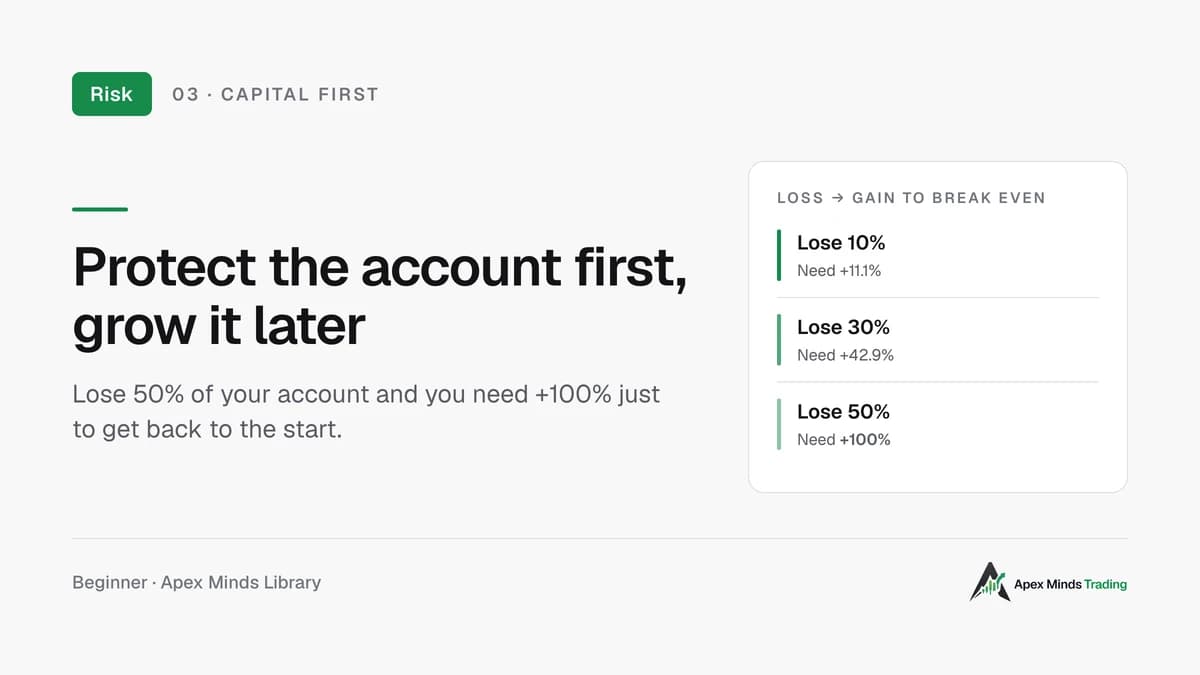
Lose 50% of the account and you need +100% just to get back. This post shares how to never stand there.
Say your account holds $10,000. After a bad month it is down to $5,000. You have lost 50%.
To get back to $10,000 you need to make $5,000. But you only have $5,000 left to trade with, so that $5,000 is a 100% gain: you have to double what is left. Losing half is easy. Doubling an account is something very few traders ever do.
That is why every serious trading book says the same thing: protect the account first, grow it later.
The math of losses: the deeper the hole, the harder the climb
After every loss you have less capital to earn it back with, so the percentage gain you need is always larger than the percentage you lost. The formula:
Gain needed to break even = % loss ÷ (1 − % loss)
In practice:
- Lose 10%, need +11.1%
- Lose 20%, need +25%
- Lose 30%, need +42.9%
- Lose 50%, need +100%
- Lose 80%, need +400%
- Lose 90%, need +900%
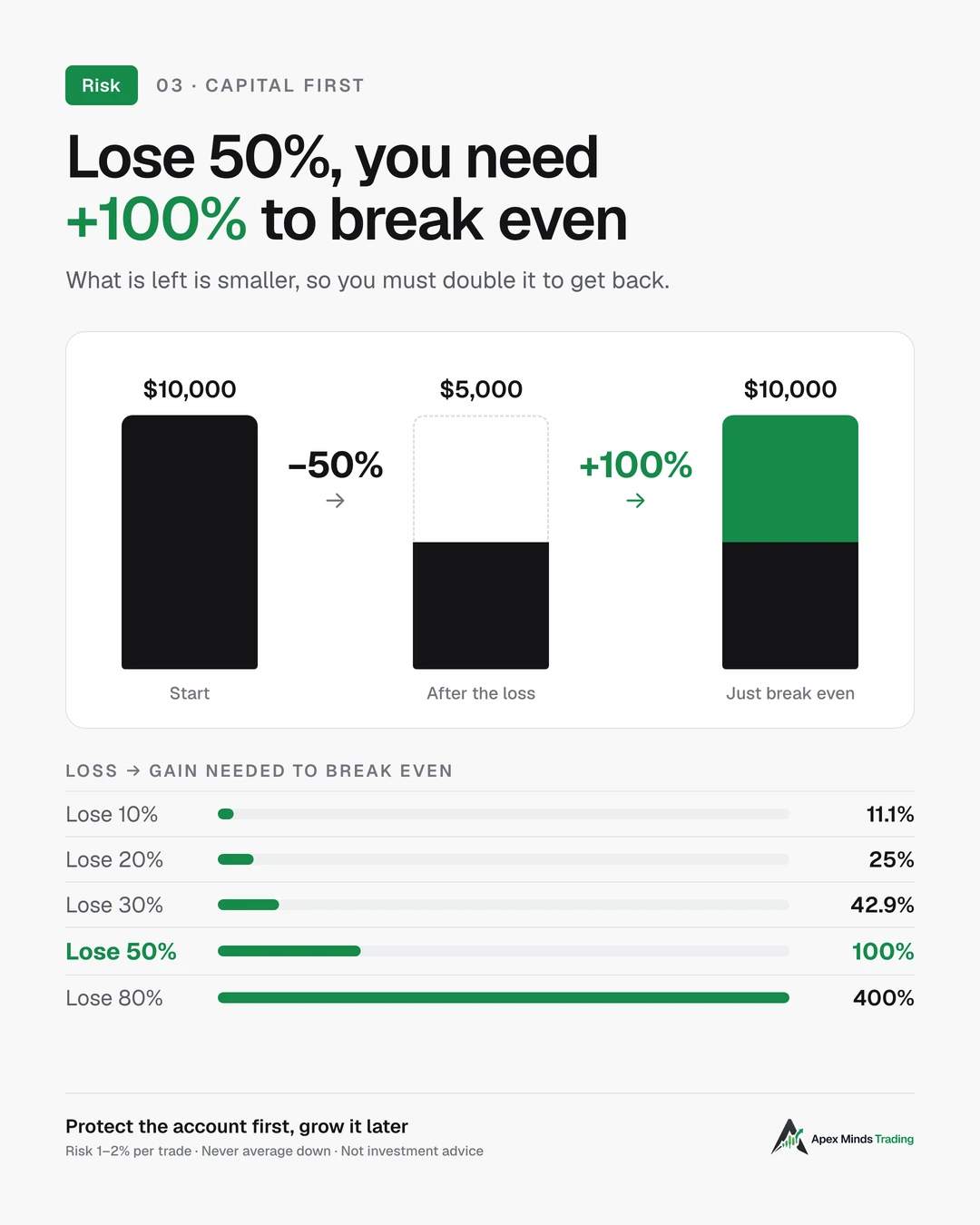
For small losses the gap barely matters. From around 30% onwards, the recovery number takes off.
Adam Grimes, in The Art and Science of Trading, points out something simple that many people forget: percentages are not additive. A $10 loss followed by a $10 gain puts you back at zero. But a 10% loss followed by a 10% gain is still a loss. Try it with $100: lose 10% and you have $90, gain 10% of $90 and you have $99.
Al Brooks, in Trading Price Action: Trends, describes hedge funds whose managers only earn incentive fees above the fund's previous high. If a fund falls 30% in a year, it needs to make "about 50%" to get back to that level. Brooks is rounding; the exact figure from the formula is 42.9%. Either way the conclusion is the same: you must gain much more than you lost. Brooks also reminds us how far even big names can fall: Cisco lost 90% of its value in the three years after 2000, which means it needed a 900% rise just to get back.
Survive first
Andrew Aziz, author of How to Day Trade for a Living, has a favourite saying: "live to play another day." According to Aziz, the number one reason new traders fail is that they can't manage their losses. By the time they learn risk management, their accounts are often badly, if not irreparably, damaged.
He puts it plainly: you may not want to take a $50 loss, but you definitely don't want to take a $200 loss afterwards.
Bob Volman, in Understanding Price Action, makes a similar point when talking about trade selection: rather than aiming to maximise the positive, it is more essential to minimise the negative. Protect your account from unnecessary setbacks and it has a good chance to grow along with you.
So how do you make sure you never end up 50% down? These authors agree on four rules.
Rule 1: risk only 1–2% of your account per trade
Aziz sets a hard limit: never risk more than 2% of your account on a single trade. On a $10,000 account, that is at most $200 per trade. If a sensible stop would force you to risk more than 2%, skip the trade and wait for another one. Volman also recommends 1–2% and strongly advises against going above 2%.
Why such a small number? Look at what happens after 10 losing trades in a row, something every trader will go through:
- Risking 1% per trade: about 90% of the account is left
- Risking 2% per trade: about 82% is left
- Risking 5% per trade: about 60% is left
- Risking 10% per trade: about 35% is left, a 65% loss that needs more than +180% to recover
Same losing streak: the trader risking 1% is fine, the trader risking 10% may never recover.
Rule 2: size every trade in 3 steps
Aziz uses a three-step process before every trade:
- Maximum amount you are willing to lose = account × 1% (or at most 2%). Work this out before the session starts.
- Risk per unit = the distance from your entry to your stop loss. The stop must sit at a sensible technical level, not pulled closer to make the numbers look nice.
- Maximum position size = Step 1 ÷ Step 2.
Aziz's own example (stocks): a $40,000 account, choosing to risk 1%, which is $400. Short at $50 with a stop at $50.40, so $0.40 of risk per share. Maximum size: $400 ÷ $0.40 = 1,000 shares. You may trade less, never more.
Applied to XAU/USD (an Apex example):
- $10,000 account × 1% = $100
- Buy, with the stop loss $5 below entry
- With a standard 100 oz contract, one lot loses 5 × 100 = $500 if the stop is hit
- Maximum size: $100 ÷ $500 = 0.20 lot
Gold contract sizes differ between brokers, so check your broker's specifications before you calculate.
Rule 3: when the account shrinks, so do your trades
Because risk is a percentage of current equity, your position size shrinks automatically when the account falls. If the account goes from $10,000 to $9,000, the 1% risk on the next trade is $90 instead of $100. Bob Volman calls this compounding: more capital means bigger size, less capital means smaller size, and the risk percentage stays the same.
Volman gives an example of how protective this is. A trader starts with $5,000, risks 2% per trade, and does so badly that he loses 2.5 times his stop every single week, that is 5% of the account per week, for 48 weeks straight. Because his size keeps shrinking with the account, after 48 weeks he still has about $426. The account never reaches zero.
Read this example correctly: $426 left means more than 91% has been lost. It only shows that sizing as a percentage of equity keeps an account from being wiped out completely. It does not mean you are safe. Volman himself says this holds "theoretically", and mainly for Forex, where you can trade very small sizes. He adds two more points:
- Traders who are still losing should practise on a demo account or with tiny size, and not think about growing the account yet.
- Adding money to a shrinking account to "trade bigger and win it back" is folly.
Rule 4: never average down a losing trade
Aziz calls averaging down perhaps the most common mistake a beginner will make, one that will almost certainly end a short trading career.
His example: you buy 1,000 shares at $10, just above a support level. Support breaks and the price drops to $8. You should already have been stopped out, because your reason for the trade is gone. Instead you buy another 1,000 shares at $8, your average cost becomes $9, and a bounce to $9 gets you out at break-even. It sounds tempting.
Aziz admits he has tried it: about 85% of the time averaging down makes money. But the other 15% of the time it blows up the account, and those losses far outweigh the gains from the 85%. His advice: forget about it. He adds to winning trades and rarely adds to losing ones.
Averaging down is the shortest path from a 1–2% loss to a 50% drawdown.
Track your own drawdown
In Quantitative Trading Strategies Using Python, Peng Liu introduces maximum drawdown: the largest loss from the account's highest peak to its lowest point afterwards. It answers the question "in my worst stretch, how much did I lose?"
Track this number for your own account, and decide in advance the drawdown at which you stop trading real money and review your method. Look back at the list at the top: stopping at a 10–20% loss leaves a way back; reaching 50% almost means starting over.
In short
- A 50% loss needs a 100% gain to break even. The deeper the loss, the harder the recovery.
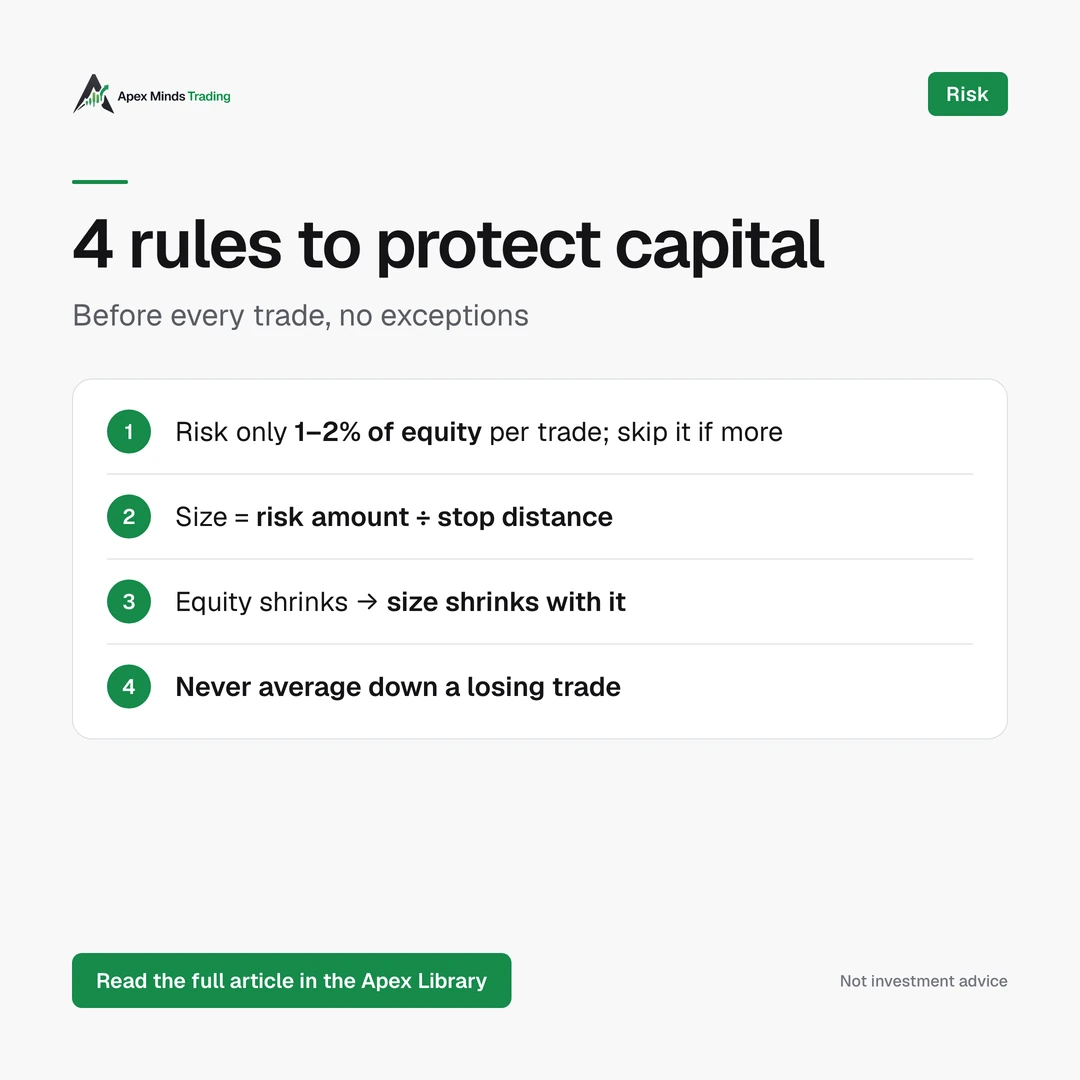
- Risk only 1–2% of your account per trade.
- Size every trade in 3 steps: risk amount ÷ stop distance.
- Let your size shrink when the account shrinks.
- Never average down a losing trade.
Growth is the reward for those who are still in the game. To see why a losing streak is normal and no reason to break your rules, read next: Think in probabilities, not each trade.
References
- Andrew Aziz, How to Day Trade for a Living, Chapter 3 "Risk and Account Management" and the section on scaling and averaging down.
- Bob Volman, Understanding Price Action, Chapter 5 "Trade Setups" and Chapter 10 "Trade Size – Compounding".
- Adam Grimes, The Art and Science of Trading, Chapter 11 "Tools for Quantitative Analysis of Market Data".
- Peng Liu, Quantitative Trading Strategies Using Python, Chapter 7 "Backtesting a Trading Strategy".
- Al Brooks, Trading Price Action: Trends.
The XAU/USD example and the 10-loss streak are illustrations calculated by Apex. This article is not investment advice.
