Trading is a business, not a gamble: the first lesson from Andrew Aziz
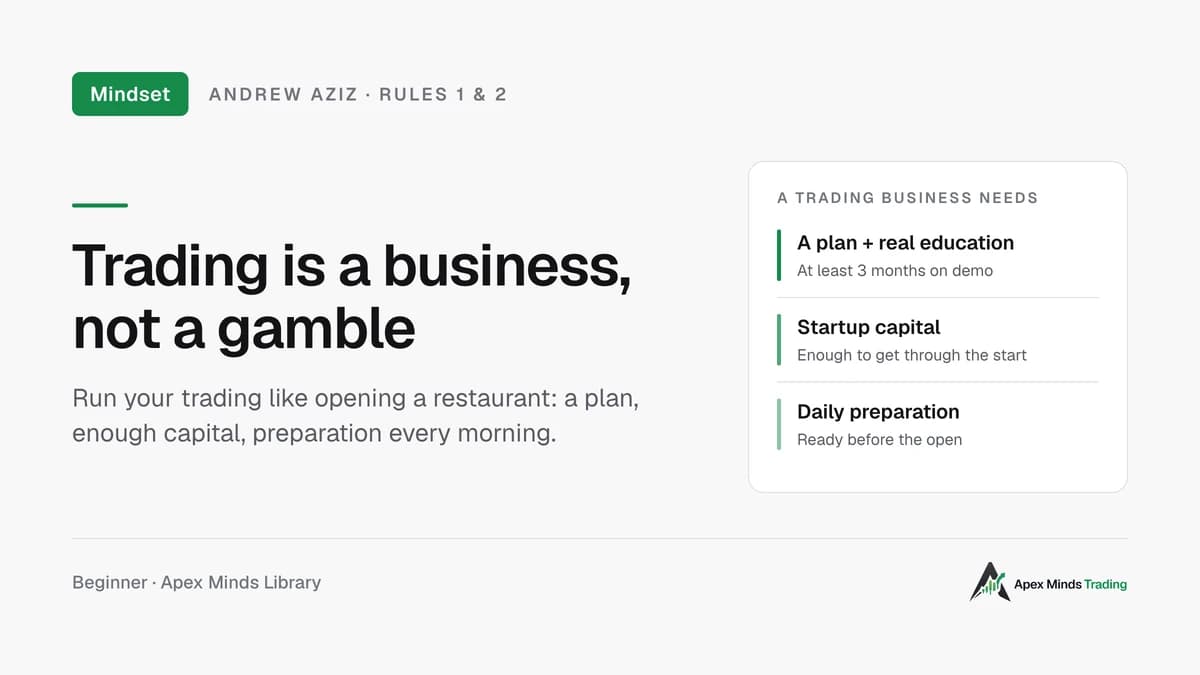
The most common reason beginners fail is treating trading as a get-rich-quick gamble. Run it like opening a restaurant: a plan, enough capital, preparation every morning.
You've seen the ads: "make money from day one", "just one simple strategy". Andrew Aziz, author of How to Day Trade for a Living, says he is always intrigued to meet people who actually believe those ads and are willing to pay for them.
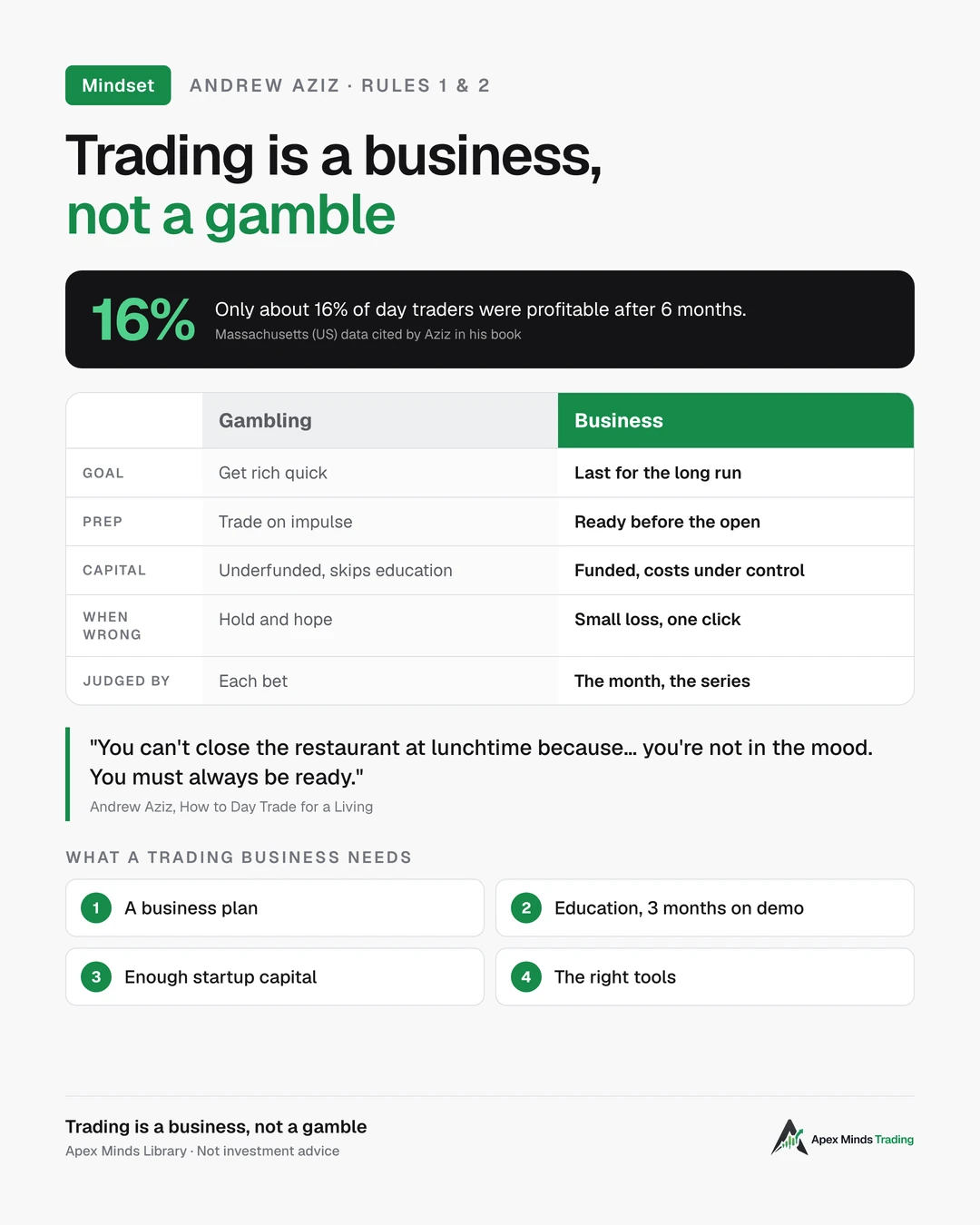
In his opening chapter, Aziz writes that the most important lesson the book can teach is that you will not get rich quickly by day trading. Day trading means opening and closing positions within the same day, never holding overnight. It is not like gambling or playing the lottery. He cites a rare piece of public data: in Massachusetts, a state court ordered brokers to release customer records, and they showed that after six months of trading, only 16% of day traders actually made money. Ending up among the other 84% is very easy.
So what separates the two groups? Aziz's answer comes down to one question: are you running a business, or are you gambling?
The most common reason beginners fail
Aziz writes:
"In my opinion, the most common reason that people fail in day trading is that they do not regard it as a serious business. They instead treat it as a form of gambling that will quickly and easily make them rich."
He describes this type of trader clearly: trading as a hobby, for fun, because it looks "cool", because they like how it makes them look to their peers. They play around in the market but never commit to a proper education. They may get lucky a few times, but eventually the market will punish them.
Aziz tells his own story. Early in his career he bought 1,000 shares of a pharmaceutical company at $4 and sold them above $10 after the company announced positive results, making over $6,000 in minutes. He admits it was pure luck: he "honestly had no idea" what he was doing. The feeling that making money was easy gave him the wrong kind of confidence, and within a few weeks he lost the whole $6,000 on other bad trades. He adds that for many people, their first mistake is also their last trade, because they blow up their account and leave.
The lesson is worth remembering: a lucky win can be more dangerous than a loss, because it teaches you the wrong thing.
Aziz's first two rules
Aziz opens the book with two rules:
"Rule 1: Day trading is not a strategy to get rich quickly."
"Rule 2: Day trading is not easy. It is a serious business, and you should treat it as such."
A few pages later he restates Rule 2 even more strongly:
"Never forget Rule 2: day trading is a business, and it's an intensely serious one."
Why is it so hard? Aziz explains that you don't create money in the market. The money you want to win belongs to other traders, and they have no intention of giving it to you. You are competing with professionals who are well educated, well equipped and very serious about making money. Being a little better than average isn't enough.
Compare it with opening a restaurant
To show what "business" really means, Aziz suggests comparing day trading with opening a pizza shop or a restaurant.
A restaurant costs a lot up front: rent, equipment, hiring and training staff, insurance, licences. And even after all that, there's no guarantee you'll make money.
Trading is far easier to start: you can open a trading account today at no cost and start trading tomorrow. Of course, Aziz is clear: don't do that before you've educated yourself.
Cash flow is easier to manage too. An importer can run into all kinds of trouble: vendors, shipping, customs, quality, with money locked up the whole time. In trading, if a trade goes wrong, you can cut the loss, closing the trade for a small loss, in seconds with a single click. Starting over is easy. Quitting is just closing the account and withdrawing your money.
That is the strength of this business, and also its trap. Because it is so easy to start, many people walk in completely unprepared, something they would never do if they had to spend a fortune opening a restaurant.
Every business needs the right equipment
If trading is a business, you need what any business needs. Aziz lists four things:
1. A business plan. Which strategies you'll use, and how much you'll invest in education, a computer, screens, software and other tools. Aziz advises beginners to set aside a dedicated education budget for their first year.
2. A proper education. Aziz asks: would you perform surgery after reading a book or two? Practise law or engineering after a few YouTube videos? Trading is no different. He recommends practising in a simulator for at least three months before trading real money.
3. Startup capital. This is the part most people skip.
"Like any other business, you need some money to start your trading business, including money for buying a good computer and three monitors, plus sufficient capital to actually begin trading with. Many businesses, including day trading businesses, fail because the entrepreneur founders lack adequate startup capital and cannot keep tight control of their overhead costs."
Two terms explained:
- Startup capital is the money you need to begin: tools, education, and the capital you actually trade with. Aziz stresses having enough to sustain break-even operations at the beginning, because it takes time before you can make a living from trading.
- Overhead costs are the regular bills you pay to keep running, win or lose. For a restaurant that's electricity and rent. For a trader it's internet, commissions, software, platform fees and community memberships if you have them.
Aziz points to two common mistakes. First, beginners cut back on the essentials such as education, tools and platform to preserve capital. He calls this trying to do too much with too little, which creates a death spiral of distress and emotional trading. Second, traders who are undercapitalised but still hope to live off trading tend to take higher risks to hit their goals, which will most likely destroy their account.
On the other hand, enough capital lets beginners make beginner's mistakes and fix their weaknesses early, before they are forced out of the business.
4. The right tools and services: high-speed internet, a good broker, a fast execution platform, a scanner to find opportunities, and a community of traders to learn from.
A restaurant can't close at lunchtime because you're "not in the mood"
This is the passage many readers remember most from the opening chapter:
"You can't close the restaurant at lunchtime because you aren't feeling well or you're not in the mood or you didn't have time to order enough groceries for the kitchen staff to prepare meals with. You must always be ready. The day trading business is no different."
For Aziz, "serious" means something very concrete: wake up early, prepare every day on what you plan to trade, and be fully ready before the market opens. No opening the chart while price is already moving and only then starting to think.
For a gold trader, that means: before the London or New York session you have already marked your price zones, have a buy/sell scenario, know what news is out today, and know your maximum risk per trade. If you're not prepared, it's like a restaurant without ingredients: don't open the doors.
No shop is profitable every single day
In the chapter on risk management, Aziz returns to the same image from another angle:
"Imagine you have a restaurant or coffee shop; would you be profitable every single day? No."
Some days the shop is quiet and sales don't cover staff or rent. Other days are busy. He shares that about 30% of his trades are losers, yet he is consistently profitable, because trading is a business of statistics and probabilities, not about being right on every trade. Good traders take many small losses.
That is the difference between a business owner and a gambler: the business owner looks at the month's books, the gambler looks at each bet.
Are you running a business or gambling?
Check yourself with these questions (compiled by Apex from Aziz's ideas):
- Do I have a written trading plan: strategy, risk per trade, trading hours?
- Have I practised on demo long enough, or am I learning with real money?
- Is my capital enough to get through the early period without profits, or do I need to make money right away to pay the bills?
- Do I know my monthly trading costs?
- Did I finish my preparation before the session today?
- Do I judge my results by the month or by each trade?
If most answers are "not yet", you are probably still in a gambler's position, even if you don't mean to be.
In short
- Trading is not a way to get rich quickly, and it isn't easy.
- The most common reason beginners fail is treating it as gambling instead of a serious business.
- Easy to start doesn't mean easy to succeed. Prepare as if you were opening a restaurant: a plan, education, startup capital, tools.
- Being underfunded and cutting the essentials leads to emotional trading and excessive risk.
- Be ready before the open every day.
- Like any shop, you won't profit every day. Look at results over the whole series.
Next, read The trader's three-legged stool for the three foundations your "trading business" needs.
References
- Andrew Aziz, How to Day Trade for a Living, Chapter 1 "Introduction" (Rules 1 and 2, the restaurant comparison, startup capital and tools), Chapter 2 "How Day Trading Works" (the definition of day trading) and Chapter 3 "Risk and Account Management" (the coffee shop example).
Trading forex, gold, stocks and leveraged products carries a high level of risk and you can lose all of your capital. This article is for educational purposes only, is not investment advice and does not promise profits.
