Doing right matters more than thinking right: execution psychology from Adam Grimes and Bob Volman
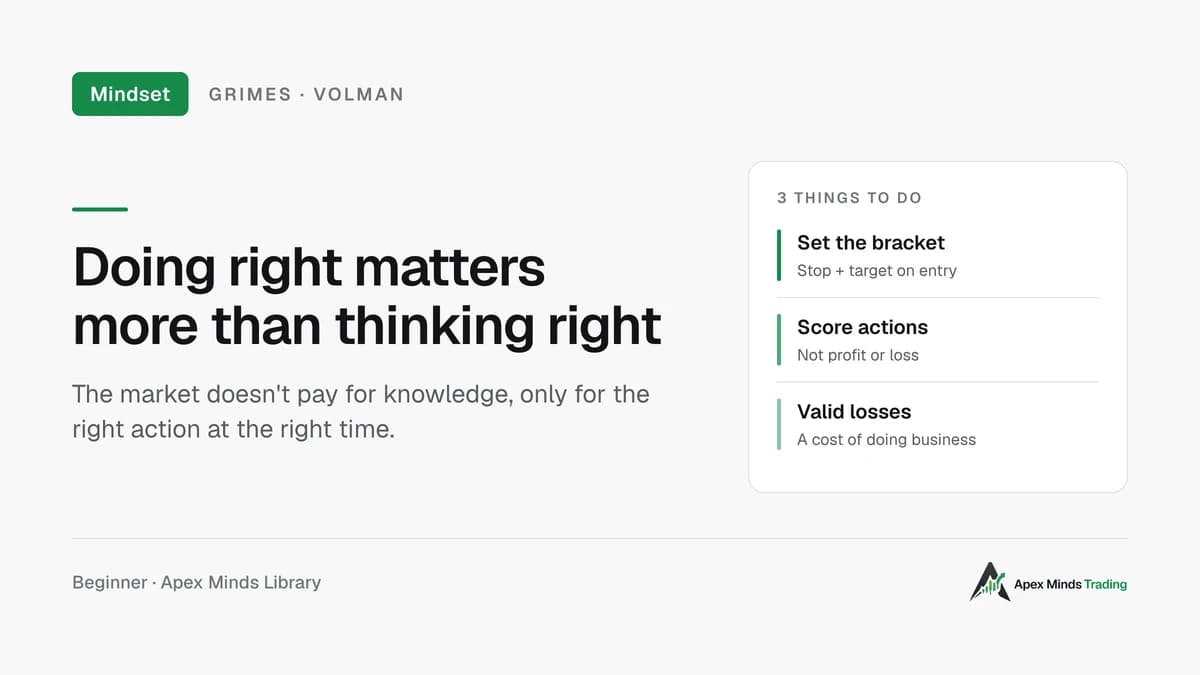
The market doesn't pay for knowledge, only for the right action. Why you should set your stop and target in advance, and not let your ego close the trade for you.
You've read the books, you know your setup, you know where your stop goes, you know not to average down. Yet in the session you still close trades early out of fear, still take trades out of boredom, still move your stop "just a little further".
Two authors Apex often draws on, Adam Grimes (The Art and Science of Trading) and Bob Volman (Understanding Price Action), reach the same conclusion: the market doesn't pay you for what you know, only for what you do. This article walks through their key ideas, with the original quotes, and turns them into a few rules you can apply right away.
Part 1 – Adam Grimes: the market only scores your actions
Orthopraxy: doing right, not just thinking right
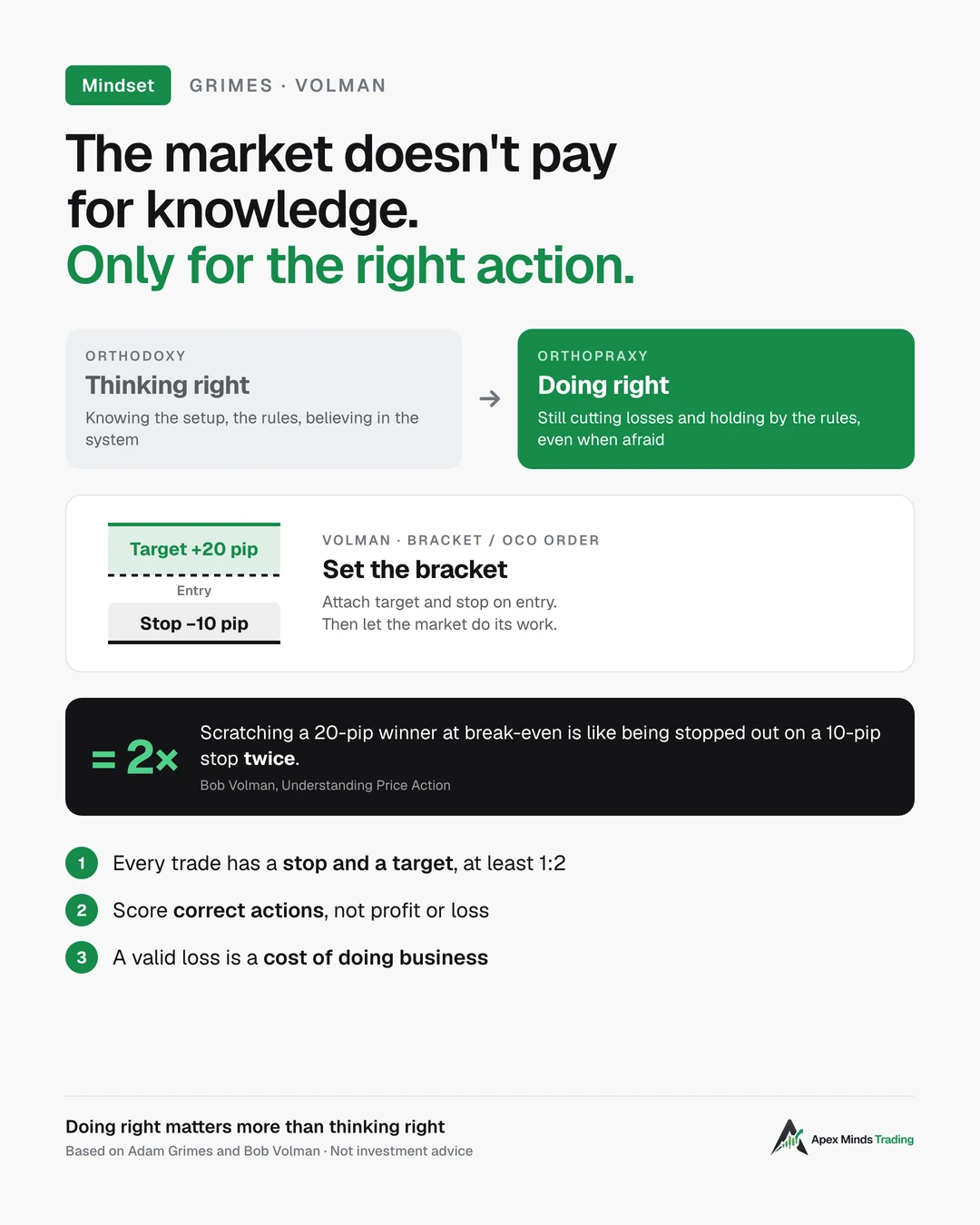
Grimes uses an unusual word: orthopraxy. "Ortho" means correct, "praxy" means practice: doing the right thing. Its counterpart is orthodoxy, right belief.
His point is blunt: you can have all the belief, confidence and knowledge in the world, but if you don't do the right thing, none of it matters.
"The market rewards us for being orthopractical traders—for doing the right thing at the right time."
Grimes lists the ways to lose: paralysed by fear, you lose; excited and taking positions too large, you lose; ignoring your exits and hoping, you lose; lazy and absent when it matters, you lose. Then comes a line worth remembering:
"If you're fearful, excited, bored, tired or whatever and you still do the right thing, then you have a chance."
This is freeing for many traders: you don't need to erase your emotions. You are not a machine. You are allowed to feel fear, as long as you still cut the loss in the right place and still hold the trade to its planned target.
But psychology doesn't replace an edge
Grimes doesn't overrate psychology either. He states his personal view plainly:
"Trading psychology is often overemphasized at the expense of actually having an edge in the market."
An edge is a way of trading that produces a positive result when repeated many times. Grimes pushes back on sayings like "trading is 100% psychology" or "you only trade your beliefs", arguing that such statements can't be proven true or false and so don't help traders. Put simply: good psychology with a method that has no edge only helps you lose more calmly. Psychology is there to execute an edge you already have, not to replace it.
Your job is not "to trade"
In "Your Many Hats", Grimes points to a trap hidden in the word "trader". A truck driver drives trucks and a baker bakes, so people assume a trader must trade constantly. When the market offers nothing, the trader gets restless and takes a trade to relieve the boredom, what he calls a "boredom" trade. It rarely ends well.
"Your job is to put on the trades dictated by your methodology and your system."
He goes further: your job is not to make money, not to put on trades, not to catch every move. The market can make a big move without your system ever giving a signal, and that's fine. Your job is to follow your system at the right time. Understand that, and many pieces of the discipline puzzle fall into place.
Be a bricklayer
"Proper, professional trading is anything but exciting—it is routine, and, hopefully, predictable."
Grimes recalls a friend's comparison: being a trader is a lot like being a bricklayer. Brick, mortar, smooth it, next brick, every day. The wall grows, but each step is routine. What traders need is structure, routine, and a method built on repeating market behaviour. What they don't need is excitement.
He quotes Ed Seykota's famous line from Jack Schwager's Market Wizards: "Win or lose, everybody gets what they want out of the market." People who come for excitement will find excitement. But as Grimes notes, exciting trading and making money rarely overlap.
Losses are spoiled lettuce
"The best mental state is simply to not care about the outcome of any one trade."
The reason: your results are the sum of your wins and losses, and losses are certain to come. Grimes uses the image of a grocery store owner: a thriving store still has some lettuce that spoils before it can be sold. The owner doesn't agonise over it, because it's a cost of doing business. No lettuce, no spoilage, but also nothing to sell.
"Your losses are your cost of doing business and you cannot have profits without those losses."
He advises thinking over the next 20 trades, not the next single trade. And he stresses that "not caring" here does not mean being irresponsible. You still do the hard work, stay perfectly disciplined and manage every other risk. You simply stop putting your emotions into the outcome of each individual trade.
Part 2 – Bob Volman: set the bracket, don't let your ego push the button
The bracket order: a fixed frame for every trade
In Chapter 4, "Orders, Target and Stop", Volman describes how he manages trades: on entry, he attaches a 20-pip target and a 10-pip stop. This is a bracket order, called OCO (One Cancels the Other) on many platforms: when one side fills, the other is cancelled.
He explains the 1:2 ratio in practical terms: if you get stopped out twice for every time the target is hit, the result over time is break-even. If you get one winner for every loser, things are progressing very well. He also advises using a market order for the stop so it is sure to fill, rather than a limit order to save a few tenths of a pip of slippage.
Why not just exit "by feel"? Volman answers:
"Anyone even vaguely susceptible to spur-of-the-moment paranoia, or greed for that matter, is probably better off putting faith in his bracket rather than in his own perceptions."
The "little demon" of an open position
At the start of Chapter 6, "Manual Exits", Volman returns to this. With a fixed bracket there are only two outcomes: the target is hit for 20 pips, or the stop is hit for a loss of 10. He makes no claim that this is the best way to manage trades, but it solves a very common problem:
"The loss of mental stability when exposed in the market."
Volman calls it an occupational hazard that sooner or later affects every trader, experienced ones included. He notes that many psychologists have studied its roots without offering much of a cure, and for that reason, in his view, praise should go to the inventors of the bracket.
Notably, Volman isn't dogmatic: right after this he writes that sticking to the bracket religiously isn't always the most sensible approach, for example when price approaches a major barrier before reaching the target. That is what the chapter on manual exits is about. But a manual exit must be a rule decided in advance, not a fear reflex.
Egos don't think in probabilities
Volman describes a familiar habit: a trade is in profit, price comes back near the entry, and the trader rushes to close at break-even. Why?
"For egos do not think in probabilities, they have an agenda fully of their own: to protect the mind from the pain and shame of seeing a once profitable trade turn red."
And he points out the cost of that reflex (this line is often quoted only in part; here it is in full):
"Missing out on 20 pip profit by scratching a valid trade at break-even is essentially synonymous to being shaken out twice on a 10 pip stop."
Volman adds a warning: never get into the habit of spontaneously lowering your target. Once you allow it, premature exits quickly become the new standard, and many trades will never reach their full potential.
Why early exits break a system: a quick calculation
Suppose you use a 10-pip stop and a 20-pip target, and out of 10 trades 4 hit the target and 6 hit the stop (an illustration):
- Following the bracket: 4 × 20 = +80 pips; 6 × 10 = −60 pips. Total +20 pips.
- Scratching 2 of the 4 winners at break-even: 2 × 20 = +40 pips; 6 × 10 = −60 pips. Total −20 pips.
Same method, same entries, but two ego-driven clicks turn a profit into a loss. At 1:2, each winner has to carry two losers; cutting winners short breaks the balance of the system.
Three rules to apply now
1. Set the bracket on entry. Every trade has a stop and a target attached (bracket/OCO), at a ratio of at least 1:2. Only exit manually on a clear technical signal written into your plan, such as price stalling just before a major barrier. Never exit because you "feel scared".
2. Score actions, not profit or loss. At the end of the day, ask three questions about each trade: did it follow the system's signal? Was the amount at risk within 1–2% of the account? Did I move the stop or exit early? A losing trade done right is a good trade; a winning trade that broke the rules is still a bad one.
3. Treat valid losses as a cost of doing business. A loss taken by the rules is the grocer's spoiled lettuce. No agonising, no revenge on the market, no averaging down to win it back. Judge results over a series of 20 trades, not one at a time.
On the 1–2% limit: this is a cap on the amount risked per trade relative to the account, not on stop distance. Volman recommends risking between 1 and 2% of capital per trade (Chapter 10), and Andrew Aziz also sets a 2% maximum. For position sizing, see Capital management: protect the account first, grow later.
In short
- The market doesn't score knowledge, only the right action at the right time.
- You are allowed to feel emotions, as long as you still do the right thing.
- Psychology only matters once you have an edge.
- Your job is to follow your system, not to trade out of boredom.
- Set your stop and target in advance; don't let your ego push the close button.
- A valid loss is a cost of doing business.
To place these ideas in the bigger picture, read The trader's three-legged stool.
References
- Adam Grimes, The Art and Science of Trading: Chapter 9 "Practical Trading Psychology" (sections "On Dealing with Loss" and "The One Thing—The Only Thing—That Matters") and the book's accompanying readings ("Your Many Hats", the bricklayer piece).
- Bob Volman, Understanding Price Action: Chapter 4 "Orders, Target and Stop", Chapter 6 "Manual Exits", Chapter 10 "Trade Size – Compounding".
- Jack D. Schwager, Market Wizards (interview with Ed Seykota).
Trading forex, gold and leveraged products carries a high level of risk and you can lose all of your capital. This article is for educational purposes only, is not investment advice and does not promise profits. All figures are illustrations.
